Navigation Activity
marketing pages
top nav

The way engineers work has changed, but the way teams hire and develop engineering talent hasn't kept up.
This three-part playbook is for tech leaders designing, hiring and growing engineering teams in the AI era – and for engineers who want to stand out in it.
A few years ago, a frontend engineer didn't need to care about why a feature existed. Pick up the ticket, build it, ship it. That was the job.
After hosting Tech Leader Exchanges with 60+ engineering leaders, we heard the same thing repeatedly: that expectation is shifting. Teams are staying lean, stack is no longer what separates good engineers from great ones, and AI fluency is quickly becoming the baseline. The constraint used to be building. Now it’s judgement.
The old stack
"Backend engineer. 5+ years. Python, PostgreSQL, Docker."
The new stack



"Backend engineer with experience in FinTech, obsessive about audit-trail design, observability, and how regulatory constraints shape API contracts. Builds AI into every part of how they work, from writing and reviewing to testing."
Any engineer can build faster with AI. The next-gen engineer knows what's worth building. They've moved upstream, from implementing solutions to defining problems. They collaborate across the full cycle, evaluate trade-offs, and bring enough context about the customer, the industry, and the business to make judgement calls.
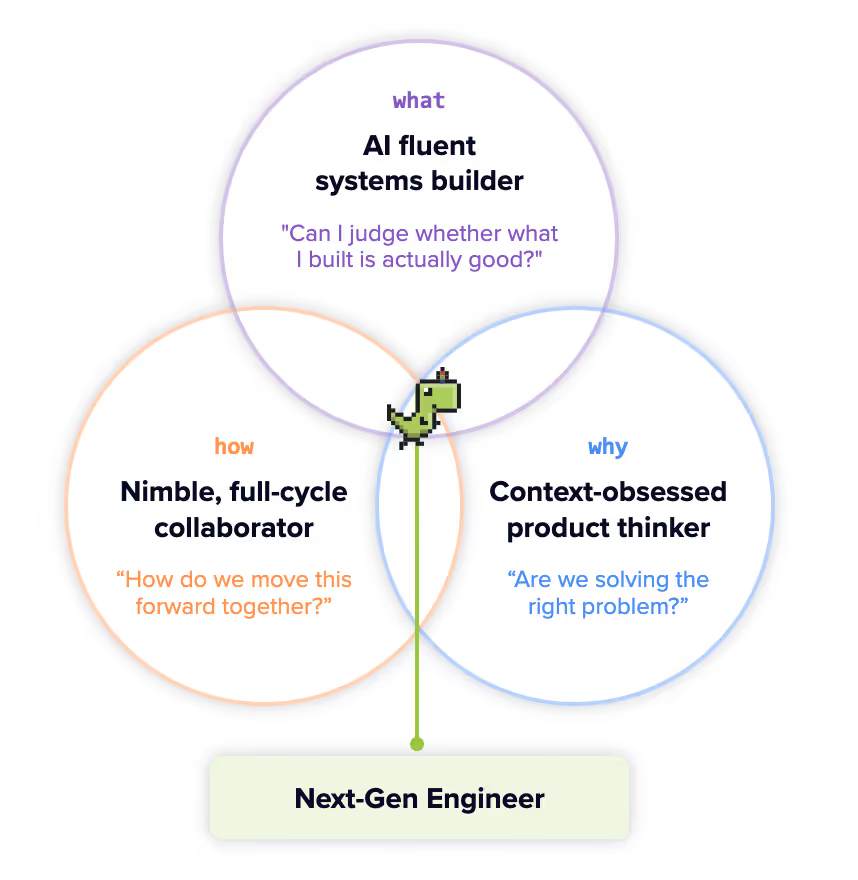



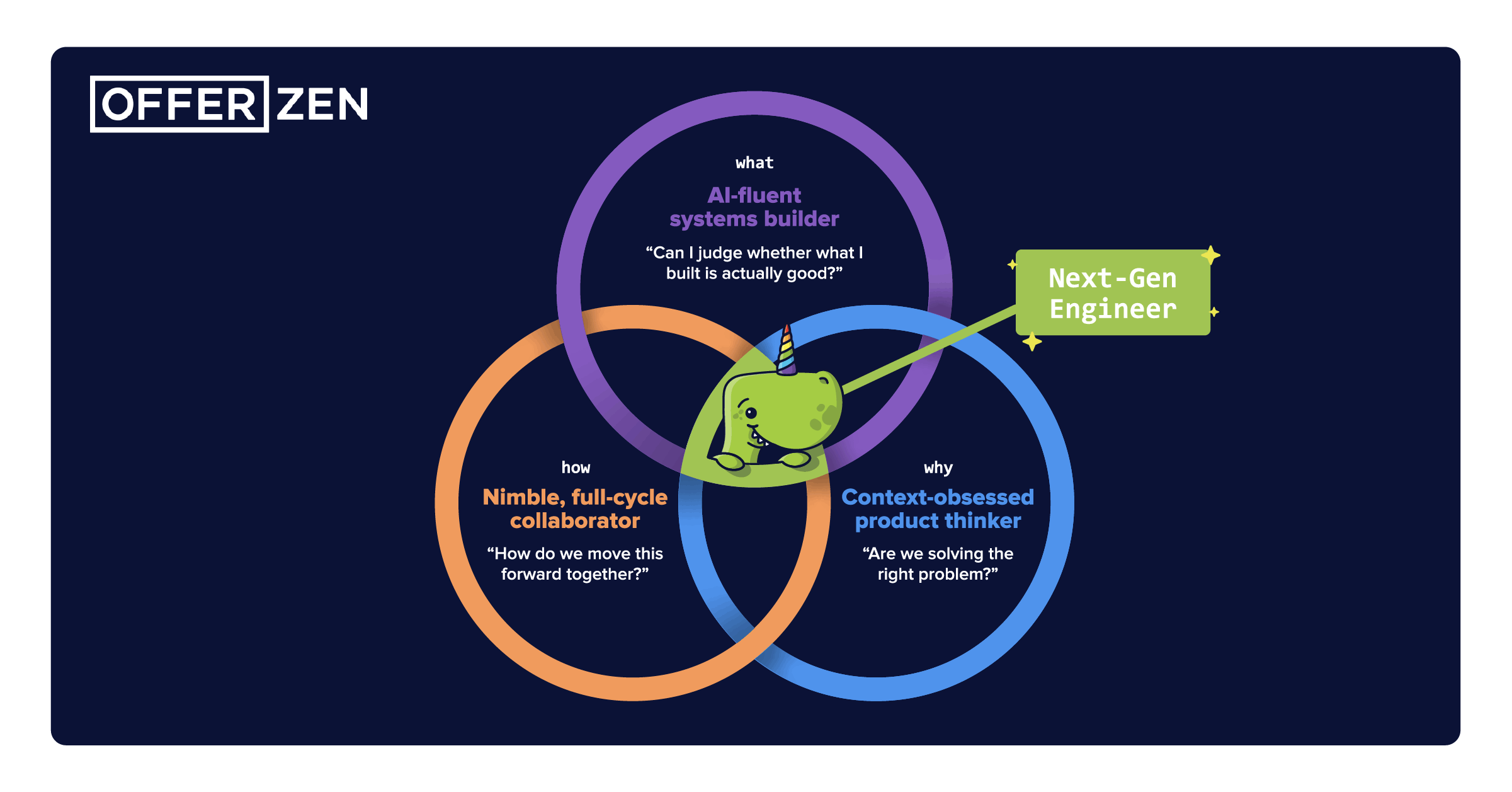
Download the framework

Refuses AI's average answer to protect the product's identity
Thinks across the whole system and defines what “good” looks like before generation starts.

Eval-first: defines the expected output before the AI produces it
Force multiplier: uses AI to move faster without losing the ability to work without it
Worldview defense: identifies when new code violates what the system is built to be
Failure recognition: spots common AI failure modes before they reach production
Output ownership: calibrates trust in AI: knows when to accept, revise, or discard what it produces

Proactive ownership across the full cycle, not just their part of it
Moves from waiting for a spec to shaping the solution. Stays involved from problem to
delivery.

Context carrier: holds full context across the cycle, not just their part of it
Blocker surfacer: raises problems early instead of sitting on them alone
Co-builds: works with designers and PMs from problem to solution, not just at handoff
Self-directed: takes ownership of what needs doing next without waiting to be assigned it
Clear communicator: can walk a customer, a PM, or an exec through a technical decision without losing them

Starts with the problem, not the solution
Understands the business, customer and market well enough to know what's worth building.

Problem-first: articulates the customer problem before thinking about the solution
Brief challenger: questions what has been asked before accepting it and pushes back when the problem is wrong, not just the solution
Commercially aware: understands how the business makes money and builds accordingly
Domain depth: knows the industry, the customer, and the constraints, not just the stack
Outcome over output: measures success by customer impact, not features shipped

Ships fast but risks solving the wrong problem with no clear user or business impact
Collaborates well but risks moving too slowly or solving the wrong problem
Knows exactly what to build, but risks moving too slowly too ship it

/definition_ai-fluency; The ability to direct AI with intent and own the quality of what comes out. Not which tools you use – whether you can define what "good" looks like before AI produces anything, and catch it when it's wrong.
Here’s your playbook for designing, hiring and growing high-performing engineering teams in the AI era – plus The Technical Assessment Toolkit to help you identify next-gen engineers.
Prefer to hear this live? Watch the panel discussion with engineering leaders and hiring specialists on what next-gen hiring looks like in practice. Watch on demand.
Team design directly shapes what gets built, how handoffs and decisions move across the full cycle, and how well your team’s AI mix actually delivers.
.avif)
"I think we will have smaller teams with distributed decision making — because now the feedback loop is so fast, you need decision making in the room. You can't have people waiting."
— Stephan Swart, Fractional CTO – Leadership Lessons AMA
Many hiring briefs ask for AI engineers but the role teams actually need is usually something different.
The question worth asking first:

This helps you decide on what type of engineer your team actually needs and what signals you need to assess for:

Ships faster by integrating AI into daily workflows.
Shows strong AI fluency through intentional prompting, critical evaluation of outputs, error detection, and consistent quality control.
You can help your engineers transition by giving them real AI products to build and ship.





Builds AI products with a strong understanding of prompting, evaluation, reliability, and system constraints.
Treats AI behaviour and output quality as core parts of the architecture.
Now it's time to zoom out. Knowing the role you need is step one. Step two is understanding how your existing team actually uses AI because that shapes what your hiring needs to complement.
We mapped 5 distinct patterns in how engineers think about and work with AI. Run the AI Engineering Archetypes quiz across your team to see which patterns are missing and what that gap is costing you in velocity, quality, or both.
Meet the OfferZen AI Engineering Archetypes:
Extend patterns and maximize AI leverage across the entire team.
Steer agents at high abstraction to ship fast without sacrificing quality.
Use AI to engage with codebases meaningfully, without being a dev.
Stay close to the code because domain expertise exceeds AI's capabilities.
Stay close to the code
because domain expertise exceeds AI's capabilities.
Build the tech craft through close AI collaboration, questioning every line.
Build the tech craft through close AI collaboration, questioning every line.

/team-diagnostic;
_capability-gap
"If everyone is a Builder, who's focused on elevating the whole team?"

Multiplier
"If no one on your team is actively learning, how are you keeping their skills sharp?"

Apprentice
“If you're building in less-charted territory, who's writing the code AI has never seen?"

Artisan
“If your devs are still the first stop for every hard technical question, is your entire team really AI enabled?”

Explorer
"If your backlog grows faster than your team can ship, who's closing the gap?"

Builder
/up-next;
What matters now is how someone thinks, where they are in their AI journey, and whether they have the product taste and judgement to know what's worth building in the first place.
of teams are focused on filling specific high-impact roles, not broad team growth
of tech leaders already expect AI fluency as a baseline, not a bonus
of leaders now expect higher productivity per engineer than in previous years
State of SA's Developer Nation: Salary and Benefits Report 2026
Most engineering job specs still read like a task list. This one is built around outcomes, judgement, and AI fluency as a baseline, so you attract engineers who are ready to take on higher value work.
How to use it: Copy this prompt into your AI tool of choice, fill in the bracketed fields with your actual context, and it'll generate a complete job spec you can edit and post.
Using the context below, write a complete job spec. Output the job spec directly, section by section, starting with "Who we are".
ROLE
You are a tech hiring manager writing a job spec for a [ROLE TITLE — e.g. Senior Engineer / Full-Stack Engineer / Engineering Manager]


You’ve generated the job spec. Now comes the harder part: finding engineers with the kind of AI capability your team actually needs when everyone lists “AI” on their CV.
OfferZen’s new candidate profiles help you assess AI fluency through how engineers work, what they’ve built, and the projects behind their experience. Select the capabilities your team needs and meet candidates worth speaking to.
Types of AI fluency capabilities:
Builds AI into how they work day to day, writing, reviewing and testing code with AI as a consistent part of the workflow.
Has shipped something powered by AI, whether that's a model integration, an agent or an AI-driven feature in front of real users.
Works at the layer below the feature. Pipelines, embeddings, vector stores, RAG. The foundations that make AI products reliable at scale.
Actively learning and experimenting, and looking for a team where that's encouraged.
.avif)
/for-hiring-managers;
.avif)
OfferZen now lets you search for AI-fluent engineers. Select the skills your team needs and get matched with engineers who actually tick the boxes that matter.
/for-developers;

Looking for your next role? Show exactly how you work with AI on your profile, and back it up with the projects that prove it.
"If I go to a candidate's GitHub page and I just see interview tests, that's a red flag. I want to see that you built something because you were curious about it. Now because it's so easy to build, I want to see you get niche on something on the side."
— Tech leader, OfferZen Tech Leader Exchange
/online-event;
Everyone's listing AI on their CV. How do you find the engineers who mean it?
Hear from engineering leaders at Pollinate and Impact.com on how they're updating their hiring process to find the right people in the AI era.
.png)
Dinielia Pillay
Talent Partner, OfferZen
.png)
Andrew Considine
Chief Product Officer, Pollinate
.png)
Tian Schoeman
GenAI Productivity
Manager, Impact.com




The strongest hiring signal today is no longer “did they complete the assignment correctly?”. It’s whether candidates can explain, defend, and reason about the decisions they made.
A take-home assignment or coding test alone is no longer enough to assess that. The interview is where judgement, ownership, and tradeoffs become visible.
.avif)
Design the exercise to reflect actual work and include constraints that force real decisions. Use time limits, deliberate ambiguity, and scope
decisions with no obvious right answer.
Example: "Build a basic search feature for a product catalogue. You have 4 hours. Assume the data is messy."
.avif)
Build the interview around the candidate’s submission and introduce new constraints as you go. Ask them to explain their decisions, priorities, and trade-offs. The goal is to understand how they think, not just whether the solution works.
Example: “Your solution works for 100 records. What happens if the table contains 1 million records? Where would it break first, and how would you fix it?”
.avif)
/interview-tip; Stop asking candidates how their solution works. Ask them where it breaks. Their answer will tell you far more about their judgement than whether they used AI.

/community-pulse-check;
/free-toolkit;
Through OfferZen’s Contracting and Embedded services, we've assessed hundreds of engineering candidates for local and international companies. One thing we've learned: anyone can produce code with AI, but only engineers with strong fundamentals can evaluate that code, make sensible tradeoffs, and know what to build, skip, or simplify.
This toolkit brings those lessons together into practical guidance for making confident hiring decisions in the AI era.
.png)
/up-next;
Most teams get stuck at tool adoption. Building genuine AI fluency across a team takes deliberate effort.
“If your team can tell me they spent a significant part of their day building the system that builds the system, rather than just building the system, you've crossed the line into real AI fluency.”
— Stephan Swart, Fractional CTO – Leadership Lessons AMA
These four signs tell you whether your team is doing less reacting and more directing.

People openly share prompts, workflows, learnings and failures. AI is part of everyday collaboration, not hidden individual experimentation. Teams develop a shared language around what good AI usage looks like and where human judgement still matters.

The team continuously refines prompts, systems and processes around AI usage. Retros include how AI is shaping delivery, quality and
decision-making, helping reduce defensiveness around new ways of working.

People can explain, review and defend AI-assisted outputs. Speed has not replaced critical thinking, systems thinking or technical judgement. As trust in AI grows, human oversight shifts from line-by-line reviews toward architecture, orchestration and product quality.

AI makes it easier to build software quickly, but fluent teams stay focused on solving the right problems. Engineers think beyond code and consider user needs, product quality and business impact when deciding what should actually be built.
/online-event;
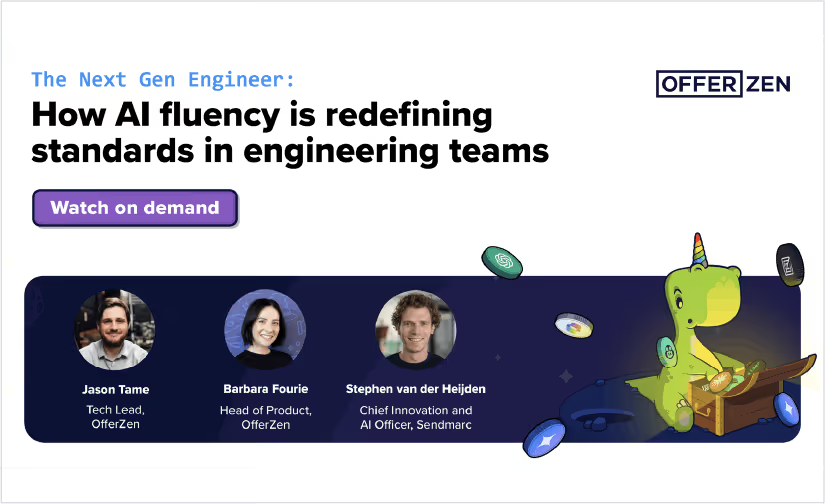
Want to go deeper on AI fluency?
Explore how AI fluency is reshaping engineering teams, product thinking and what great talent looks like in the AI era.

Jason Tame
Tech Lead, OfferZen

Barbara Fourie
Head of Product, OfferZen

Stephen van der Heijden
Chief Innovation and AI Officer, Sendmarc
Some teams just have one power user. Here's why AI capability fails to spread across teams.

ERR_01
AI adoption breaks down when teams are given tools without training, structure or support. A few people become power users while everyone else quietly disengages or resists. Without shared standards or safe spaces to experiment, adoption becomes fragmented and inconsistent.
ERR_02
AI doesn’t fix broken systems. Teams with messy workflows, unclear processes and existing tech debt often just create problems faster. Productivity may spike initially, but quality, clarity and maintainability usually drop. AI amplifies whatever operating system already exists inside the team.
ERR_03
Teams run into trouble when AI-generated work stops being properly reviewed. Engineers begin shipping outputs they haven’t fully understood, tested or validated themselves. Over time, accountability weakens and quality issues start compounding quietly in the background.
ERR_04
Most teams introduce AI the same way they introduce new software. But AI changes workflows, decision-making and how teams operate together. Without training, safe experimentation and new team habits, adoption stays shallow or creates resistance.
These plays come directly from engineering leaders who are successfully building AI into real team workflows.
01
Don’t outsource AI direction to the loudest adopters
The strongest teams treat AI adoption as a leadership responsibility, not a side project. Without clear direction, teams end up with fragmented tooling, inconsistent practices and uneven adoption. Strong leaders define where AI creates leverage, where guardrails matter and what good usage looks like across the organisation.
/tech-leader-tips;
Create clear guardrails before scaling adoption
Standardise a small set of approved tools first
Define where AI should and shouldn’t be used
Treat AI adoption as a workflow change, not just a tooling rollout
02
Adoption breaks when people are afraid to get it wrong
Most teams don’t resist AI because they dislike it. They resist it because they don’t feel safe using it. Without training, protected practice environments and time to experiment, adoption stays shallow and inconsistent. Strong teams create low-risk spaces where people can test workflows, share learnings and build confidence together.
/tech-leader-tips;
Create non-production spaces for AI experimentation
Encourage teams to share failures and learnings openly
Start small before scaling AI workflows broadly
Build regular reflection time into team workflows
03
Sustainable AI adoption comes from improving the workflow itself
The teams getting the most value from AI are not just generating faster outputs. They are refining the systems, prompts and workflows behind the work. Sustainable adoption happens when teams regularly reflect on what’s working, what’s breaking and where quality is slipping. The advantage comes from continuously improving the process, not just speeding it up.
/tech-leader-tips;
Default to review for AI-assisted work, especially on load-bearing paths
Create feedback loops around output quality
Treat prompts and workflows as shared team assets
Measure improvements to the system, not just delivery speed
04
AI should support judgement, not replace it
The strongest teams still expect people to understand, review and stand behind AI-assisted work. Early on, that might mean reviewing outputs line by line. As trust and systems mature, human judgement shifts toward higher-level decisions like architecture, orchestration and product quality. AI can accelerate execution, but sustainable adoption still depends on strong human oversight.
/tech-leader-tips;
Require review of all AI-assisted work
Ask engineers to explain generated solutions
/definition; The layer of human judgement that protects what the team believes good software should look like.
As AI systems mature, worldview defense shifts from line-by-line reviews to architecture, orchestration and product quality
Use AI to learn faster, not to skip understanding
As AI handles more execution, skills like systems thinking, product judgement and technical taste become stronger differentiators. OfferZen helps hiring teams identify those signals earlier and connect with engineers who are actively engaged, intentional about their next move, and ready for the next generation of software development.
Build your next-gen engineering team
.avif)
/free-toolkit;
Through OfferZen’s Contracting and Embedded services, we've assessed hundreds of engineering candidates for local and international companies. One thing we've learned: anyone can produce code with AI, but only engineers with strong fundamentals can evaluate that code, make sensible tradeoffs, and know what to build, skip, or simplify.
In this toolkit:
👉 Why judgement is becoming the new hiring signal
👉 A practical take-home assignment checklist
👉 What to evaluate beyond code quality
👉 A 5-step framework for designing assessments
👉 How to turn interviews into stronger hiring signal